Description
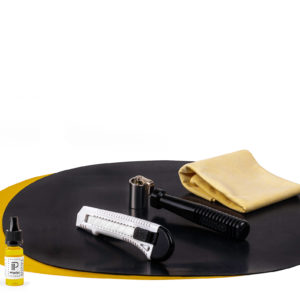
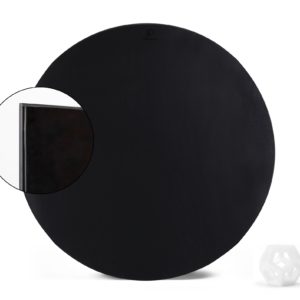
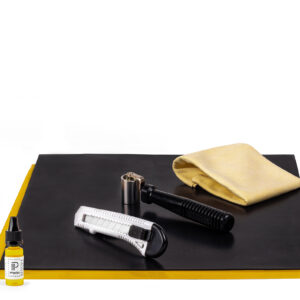
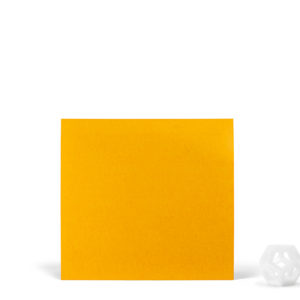
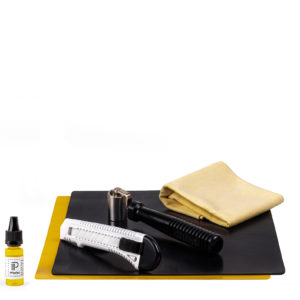
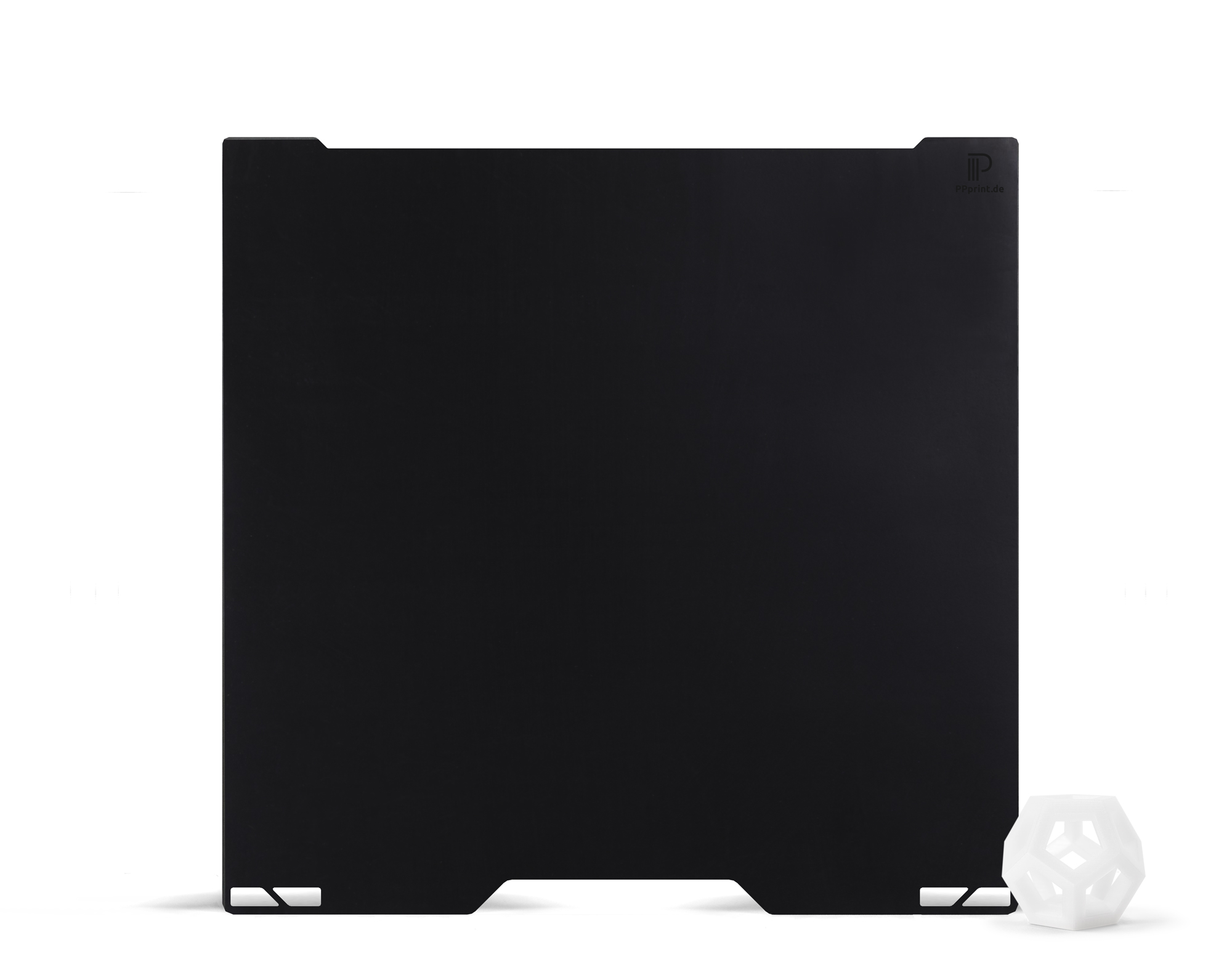
The Premium P-surface plate is a custom-fit, ready-to-use replacement plate with which PP can be successfully printed. Permanent bonding is achieved by bonding under high pressure and at high temperature. Regular cleaning and care of the P-surface 141 surface with the PPprint Cleaning-Kit restores optimal adhesion with PP or P-support, so that the premium panel can be used for a very long time.
Bambu Lab H2D/H2S: Printing with PPprint products
General Information:
When 3D printing with PP and our P-surface 141, we recommend that bed leveling be performed locally on the H2D printer in calibration mode before printing. It is sufficient to perform “Automatic Bed Calibration” and “Nozzle Offset Calibration.” The calibration data determined are always stored internally in the printer, so calibration does not need to be performed again before each print, unless the printer plate has changed. Therefore, when starting the next prints in the Bambulab Studio software, set the “Automatic Bed Calibration” and “Nozzle Offset Calibration” options to “off.”
Preconfigured filament profiles for P-filament 721 basic, P-support 279, P-TPO 835 flex, and a tailored printing process profile can be requested by email at: contact@ppprint.de
3D printing using P-filament 721:
If printing with only one extruder, e.g., P-filament 721, printing is usually successful if you set the “Automatic Bed Leveling to “off” or perform it at a maximum bed temperature of 50°C.
Preconfigured filament profile for P-filament 721 basic and a tailored printing process profile can be requested by email at: contact@ppprint.de
3D printing using both extruders (H2D):
If both extruders are required for 3D printing, the small metal plate supplied must be attached to the front left of P-surface 141. Typically, the metal plate is already pre-installed when you purchase our P-surface 141 products. The metal plate is simply placed on top and sticks firmly in place due to the self-adhesive properties of P-surface 141 when pressed lightly. It can of course be removed, but should remain in place as long as it does not interfere with printing. It does not interfere with the cleaning of P-surface 141 or with automatic calibration and can therefore remain there during single-nozzle printing.
The small metal plate is required for correct and reproducible z-offset calibration of the two nozzles.
With the small metal plate installed, dual-nozzle printing works reliably.
3D printing using P-TPO 835 flex:
Like most TPU filaments, P-TPO 835 flex cannot be operated via the AMS unit. To print with P-TPO 835 flex, it must also be connected via the external spool on the right extruder, and P-TPO 835 flex should be fed directly into the printer via the side feed.
P-support 279 or an AMS unit with P-filament 721 (various colors) or P-filament Carbon 411 can be connected to the left extruder.
Preconfigured filament profile for P-TPO 835 flex and a tailored printing process profile can be requested by email at: contact@ppprint.de